

Artificial Intelligence (AI) is revolutionizing how we think, interact, and learn. It’s also reshaping the aspirations of tomorrow’s workforce. According to the latest Lumina Foundation-Gallup 2026 State of Higher Education Study which surveyed 4,000 college students, 42% of those pursuing bachelor’s degrees and 56% working toward associate’s degrees say AI has made them seriously reconsider their academic major or field of study.
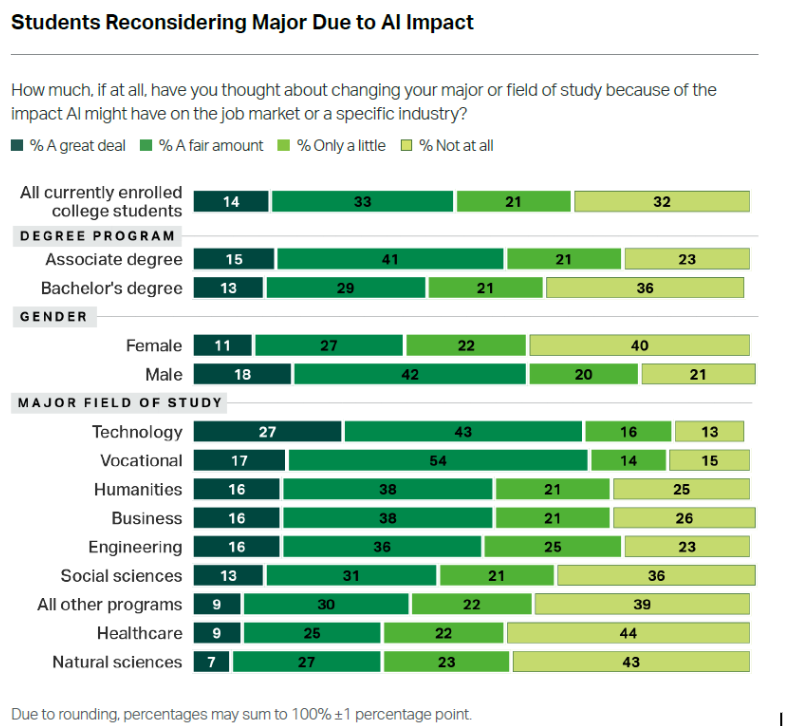
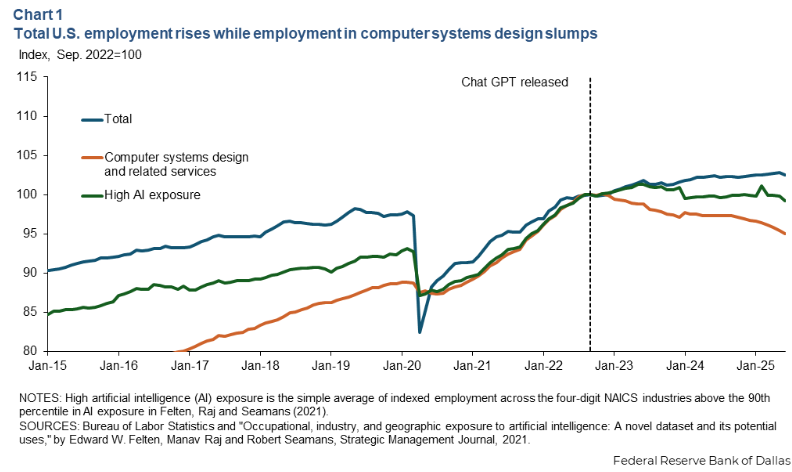
The report shows that students majoring in technology, vocational studies, humanities, and business are most likely to think about switching fields, with those studying vocational or technology subjects being more inclined to actually make the change. These results align with other research. For instance, a study by the Federal Reserve
Bank of Dallas found that while overall U.S. job growth rose by about 2.5 percent since the release of ChatGPT 3.5 in late 2022, jobs in the computer systems design and related services industry fell by 5 percent.
Entry-level jobs are most affected by the AI boom. For instance, junior software developers aged 22–25 have seen a 16% decline in employment compared to 2022 peaks according to a recent Stanford study that analyzed payroll data.
Additionally, as illustrated in the graph above, industries with “high AI exposure”—those relying on codifiable knowledge that can be learned from textbooks, representing 10 percent of all US employment—have experienced a decrease in jobs of about 1%.
Where is there growth?
The rise of AI isn’t entirely negative. Some industries have actually seen job growth since 2022, especially in roles needing “tacit knowledge” like intuition, relationship building, and making complex decisions. For example, senior developers, data scientists, and AI specialists are benefitting from AI rather than being replaced by it.
In other words, the key to getting hired and remaining employed in the AI era is learning how to apply knowledge, rather than just acquiring it.
And the demand for AI data centers will increase employment demand in the energy sector. Goldman Sachs estimates that the US will need 500,000 net new jobs to be filled by 2030 to satisfy the growing demand for power.
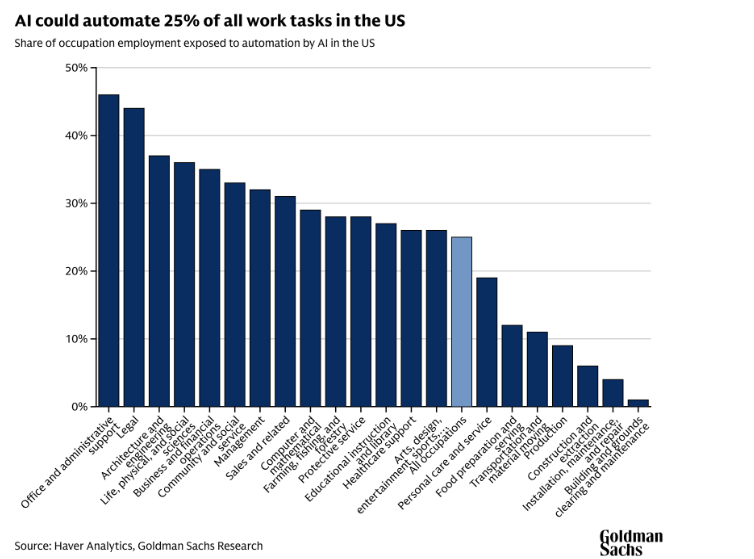
While the macro labor market is shifting, AI is projected to increase productivity of knowledge workers within dozens of sectors as well. Goldman Sachs predicts that AI will automate up to 25% of all work tasks as the chart indicates below. In some fields such as architecture, engineering, and education, the estimates for the percentage of task automation by AI are considerably higher.
This is not a cause for concern, but a call to action for higher education.
The Keys to Education in the AI Era: Experiential Learning that Complements AI
In a recent Op-Ed, Joseph Aoun, the President of Northeastern University, challenges higher education to prepare “AI natives” for a world where they can augment AI to increase their efficacy. “Instead of being on the defensive, now is the moment to shake up the way universities prepare students for the world,” he writes. “This will require updating both what and how we teach.”
In his book Robot Proof, Higher Education in an Age of Artificial Intelligence published in 2018, Aoun prophetically introduced “humanics,” a new set of literacies to train students to skillfully intersect with emerging physical, biological, and technical worlds.
Unfortunately, too many schools are failing to recognize the tectonic shift in learning that is upon us. In the same Lumina-Gallup study cited earlier, 57 percent of the college students surveyed use AI daily or weekly for schoolwork. Yet more than half of students (53%) say their institution discourages or prohibits AI use in coursework, and a majority (52 percent) of their classes lack clear guidance on specific use policies. Fewer still (nearly three in 10) say their school does not adequately prepare them to use AI. Not surprisingly, for students enrolled in institutions that have embraced AI like Northeastern, 96% say they have been adequately trained, while just 34 to 39% of students attending schools that discourage or prohibit the use of artificial intelligence, respectively say they’re prepared for the emerging workforce.
This dialectic speaks to the power of humanics!
Northeastern University has, since its inception, focused on experiential learning, blending classroom instruction with practical, real-world experience. This method not only acts as a safeguard against being replaced by automation but also equips students with that essential “tacit knowledge” skills. As stated in an Op-ed by Aoun:
Experiential learning offers particular advantages when entry-level jobs are competing with AI systems. Despite the growing power of technology, machines struggle to transition across different contexts or apply knowledge to unfamiliar scenarios. Humans excel at these tasks, and experiential learning helps us develop this ability much more effectively than traditional classroom education alone.
The Gallup-Lumina report summarizes its findings as follows:
Colleges and universities that want to ensure students not only learn effectively alongside AI but are also well-equipped to employ it in their postgraduation lives and work must continue to find ways to strike a balance in how this technology is integrated into the classroom.
At The OASIS Group, we couldn’t agree more.
About the Author
Karl Reid is the Founder and Principal of The OASIS Group. From 2021-2024, he served as Senior Vice Provost and Chief Inclusion Officer at Northeastern University.