Advancements in science, technology, engineering, mathematics, and medicine (STEMM) are fundamental to driving innovation, fostering well-being, and enhancing quality of life globally. In the United States, STEMM (Science, Technology, Engineering, Math, and Medicine) fields are pivotal for global competitiveness, national security, and economic growth, supporting 67% of all U.S. jobs and contributing 69% to the US GDP1. Addressing critical national and global challenges, such as climate change, public health crises, cybersecurity threats, and crumbling infrastructure hinges on innovative STEMM solutions.
The Growing STEMM Talent Shortage
Despite the clear demand, the U.S. is struggling to meet the burgeoning need for STEMM workers. Projections indicate a 10.4% growth in STEMM jobs between 2023 and 2033, more than double the 4% growth rate for all other occupations2. These include the broadest definition of STEMM jobs which encompass all roles heavily reliant on science, technology, engineering, and math, regardless of educational attainment. Notably, 59% of the 37 million STEM workers in the U.S. (24% of the total workforce)3 do not hold a bachelor’s degree4. Staffing agencies report a significant gap, with only one qualified professional available for every two open STEM positions. This growing talent shortage poses a substantial risk to innovation across all sectors, including healthcare, energy, manufacturing, and technology.
Addressing Underrepresentation: A Key to a Stronger STEMM Workforce
Women and people of color represent a vital, yet underdeveloped, source for the future STEMM workforce. In 2021, only 18% of female workers held STEM occupations, compared to 30% of male workers. Similarly, African Americans and Latino workers are underrepresented in STEM relative to their share of the total workforce. This lack of diversity not only affects numbers but also compromises the quality of solutions. Studies consistently show that a more diverse STEMM workforce brings a wider range of perspectives and expertise, leading to more effective solutions for complex issues.
For over 50 years, federal and state agencies, higher education institutions, schools, and non-profits in the US have aggressively worked to address this disparity, achieving positive results. However, these efforts still fall short of the increasing demand for talent, primarily due to three persistent challenges:
- – Organizational Capacity: Many organizations dedicated to identifying, equipping, and graduating STEMM students are hindered by limitations in funding, vision, and strategy. Others choose to serve a fixed number of students, wary of scaling due to concerns about losing the vital personal interactions essential to their mission and/or values.
- – Fragmentation: Organizations serving students often operate in silos, leading to competition for the same students and resources.|
- – Conventional Thinking: Despite commendable efforts, few organizations truly understand or critically examine the systemic issues that perpetuate underrepresentation in STEMM.
Project OASIS2: A Holistic Approach to STEMM Acceleration
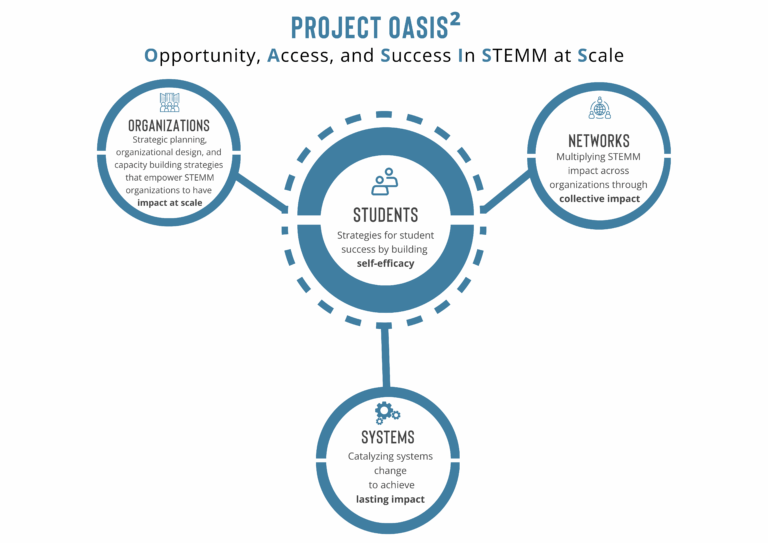
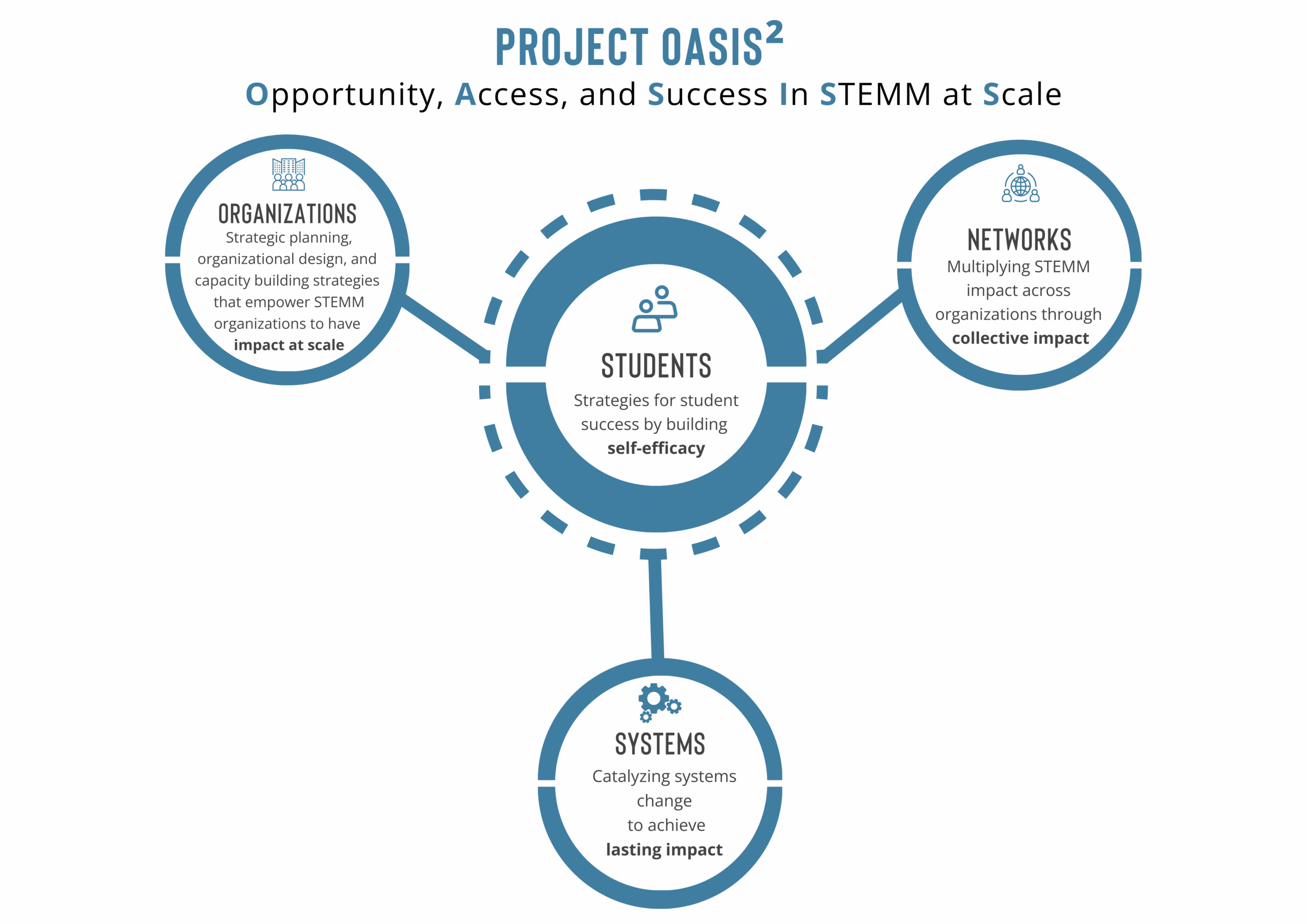
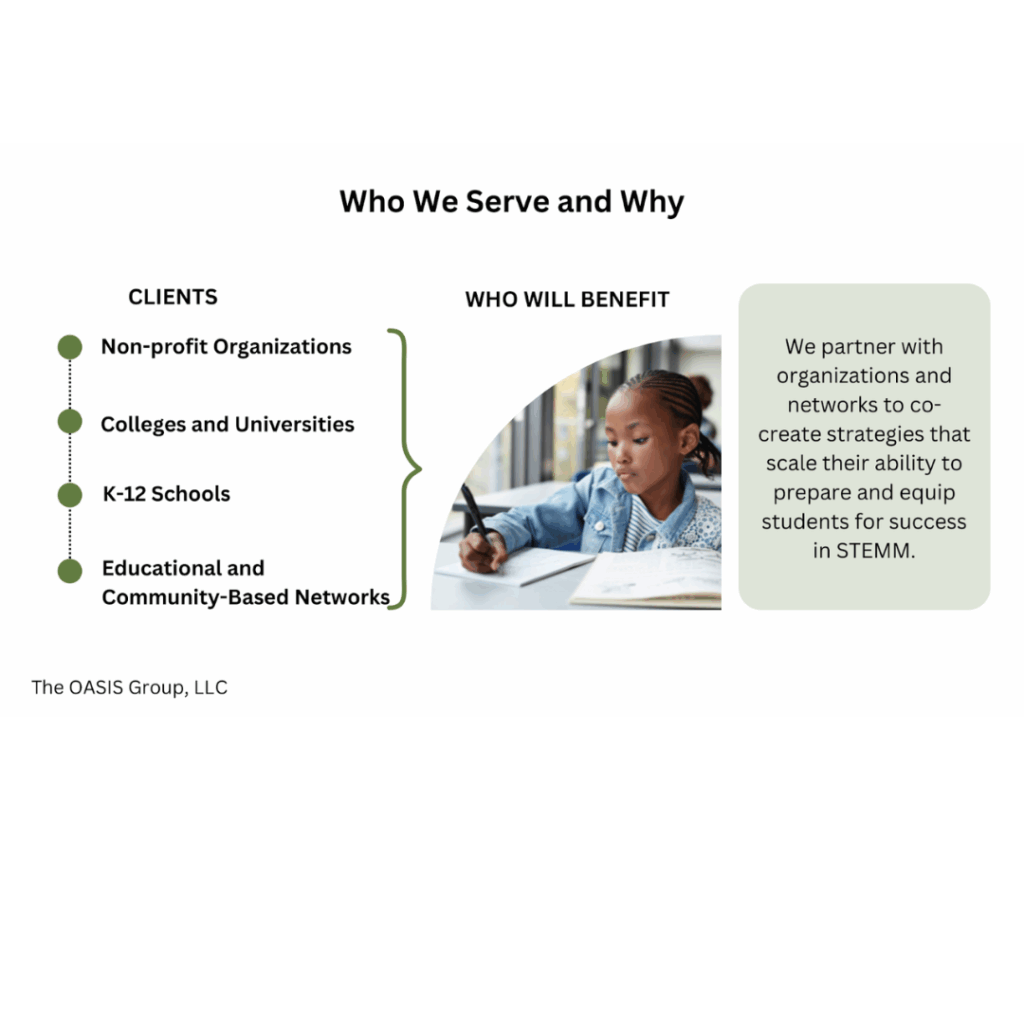
- Capacity Building: The focus is not necessarily on creating more STEMM organizations but on scaling existing ones with proven track records of success. This approach involves rigorously assessing outcomes and impact, analyzing organizational strategy and design, and challenging the constraints that limit their growth. The OASIS Group partners with organizations and institutions to co-create strategies that expand their capacity to prepare and equip students for STEMM success.
- Collective Impact: Recognizing that many STEMM institutions and organizations operate in isolation, hindering knowledge sharing, resource pooling, and achieving regional and national impact, The OASIS Group employs the Collective Impact methodology. This approach helps organizations forge partnerships and create ecosystems to solve complex social problems, such as the underrepresentation of talent in STEMM, at both regional and national levels.
- Systems Change: Drawing on the wisdom of management expert Sir Edwards Deming, who noted that “every system is perfectly aligned to produce the results it gets,” The OASIS Group emphasizes understanding, interrogating, and changing the underlying systems to achieve different results. By focusing on the root causes of underrepresentation, rather than just surface trends, we aim to create systemic conditions that enable broader adoption of programs and ultimately greater STEMM impact.
A Modern-Day “Sputnik Moment”
Many of the most pressing challenges facing the nation and the world demand innovative STEMM solutions, driven by the intellect of dedicated individuals. The current and projected demand for STEMM professionals significantly outstrips the supply. By fully tapping into every available population, not only will the social standing of underrepresented groups improve, but the entire country will benefit. Closing the gender and racial gaps alone is projected to increase U.S. GDP per capita by 2.7 percent.
Achieving this collective goal will not only boost U.S. economic growth but also ensure the nation’s continued global leadership in the advancement of science, technology, engineering, mathematics, and medicine.
About The OASIS Group
The OASIS Group offers consulting services to help organizations develop customized strategies to scale their impact on enhancing student support and success in STEMM on a broad scale.
References
- https://scienceisus.org/stem-supports-two-thirds-of-us-jobs/
- US Bureau of Labor Statistics (April 18, 2025)
- National Science Foundation (May 30, 2024)
- https://ncses.nsf.gov/pubs/nsb20245/table/LBR-2