What if every student had 24/7 access to a personalized tutor and self-guided content perfectly matched to their interests and existing knowledge? More than two decades ago, during my doctoral program for a class in teaching and learning, I wrote a paper entitled Teachers as Researchers: Examples of the Effective Use of Ethnography to Inform Teacher Practice. Drawing on Mahiri and Sablo’s1 work, I argued that effective learning depends on a teacher’s awareness of, and ability to incorporate, “situated meanings.” In other words, strong teachers function as agents of learning by “situating” content within cultural models that resonate with and motivate their students. Essentially, teachers become agents in the process of building new knowledge onto existing knowledge and cultural scaffolding. This is foundational to student learning.
I concluded my review as follows:
It is essential therefore that teachers place as much emphasis on developing cultural knowledge [of their students] as they do acquiring content knowledge.
A Student-centered Framework for Synchronized Learning
I later developed a framework for synchronized teaching built around a student-centered approach that begins with the teacher studying the attributes of each student (“teacher as researcher”) rather than leading with content, as in traditional instruction (see below).
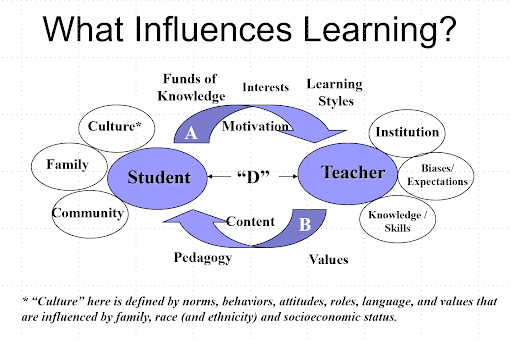
The top arrow (A) — often absent from traditional teaching models — captures students’ “funds of knowledge”2: their family experiences and belief systems, their interests, and how they prefer to absorb new information (e.g., reflective observation, active experimentation, or a blend). Here, the teacher begins their practice by studying the child’s socio-historical context, competencies, talents, interests, and learning styles, and then uses those insights to shape curriculum and pedagogy (Arrow B).
The framework acknowledges that teachers bring deep expertise and content knowledge. However, they also carry implicit biases and expectations that shape how they interpret student potential and learning. These perspectives are further shaped by the policies, practices, and the culture of the school system. Together, they influence classroom content and pedagogy (Arrow B), where instruction typically proceeds at a fixed pace. Without input from Arrow A, this remains the conventional model of learning. The goal in this optimal model is to reduce the dissonance “D” between teacher and student.
I argued then—and still believe—that learning becomes more effective as the dissonance between student and teacher decreases.
Learning theorists posit that intellectual abilities develop through social and cultural experience, and that learners build understanding in context. Therefore, classroom conditions—and the connection between teacher and student—matter.
The Good Tutor
Research consistently shows that one-on-one instruction is one of the most effective ways to learn. In 1984, educational psychologist Benjamin Bloom compared students in conventional classrooms with students supported by a good tutor, and he also examined what makes tutoring effective. Bloom found that when tutoring helps students master a topic or skill, that is, by identifying and closing gaps in understanding, those students saw improved outcomes by about two standard deviations, which in his study corresponded to moving them from the 50th to the 96th percentile.3 In short, students with personalized tutoring dramatically outperformed students in traditional classroom settings. This is also the conclusion of nearly a decade of research by Saga Education, the pioneer in high-dosage tutoring.
In short, mastery is the holy grail of education.
So, what is a good tutor? Sal Khan, founder of Khan Academy, defines it as “a caring and student-attuned instructor who presented clear learning objectives, assessments, and specialized feedback until…that student demonstrated a real grasp of the material”4.
However, because of economics, we batch students into one-size-fits-all, fixed-paced learning environments. Under the “tyranny of the content,” educators are compelled to press on to advanced topics before many students have mastered the basics, creating accumulated gaps in knowledge.
The Dilemma: Scaling Personalized Learning
A young man I mentor teaches middle school science to four classes of more than 30 students each. How can a teacher like him study every student in every class and deliver a tailored intellectual experience? How could he design customized learning for 120+ students, day after day, across an entire school year? The answer is he can’t! HThe obvious question is: how can a teacher like him truly know every student in every class and still deliver a tailored intellectual experience? For example, a young man I mentor teaches middle school science to four classes of more than 30 students each. How could he design customized learning for 120+ students, day after day, across an entire school year? The answer is he can’t!
Scale makes the problem even more daunting. In the U.S. alone, about 50 million K–12 students attend public schools and another six million attend private schools; roughly 15 million undergraduates are enrolled in two- and four-year colleges. That is about 70 million K–16 learners in the United States, and hundreds of millions more worldwide — many without access to even basic education because of limited resources, restrictive policies, and entrenched belief systems. Providing every student with a teacher—the optimal configuration—or even small-group personalization (e.g., 4–5:1) would be prohibitively expensive.
Authentic Intellectual Work
In 2000, Bryk and colleagues5 introduced “authentic intellectual work” as an educational goal. They defined authentic intellectual work as learning that empowers students to
- construct knowledge by interpreting, analyzing, or evaluating information;
- produce written communications where they draw conclusions and support and elaborate on them through extended writing; and
- introduce topics and problems that connect with student lives, that resemble situations they would encounter in daily life beyond the classroom.
From Pipe Dream to Reality
Until recently, delivering synchronized authentic intellectual work to every student was only an aspiration. Today, AI makes it feasible—and it is already being deployed.
In Brave New Words: How AI Will Revolutionize Education (and Why That’s a Good Thing), Salmon Khan, founder of Khan Academy, asks what it would take to deliver high-quality, personalized learning at scale. Founded more than 20 years ago after he began tutoring his relatives, Khan Academy now provides one-on-one tutoring for more than 150 million learners in over 50 languages worldwide.
According to a recent article, approximately 88% of US public school students have one-to-one devices in schools, and 94% of teachers use YouTube in their classroom. Since OpenAI released ChatGPT on December 22, AI use in education has surged. As I’ve previously written, 57% of college students surveyed use AI daily or weekly for schoolwork.
In 2024, Khan Academy introduced Khanmigo, an “AI-infused education platform.” Built on OpenAI’s GPT-4 large language model and trained on 20 years of Khan Academy content, Khanmigo is designed to coach students—not just give answers—using prompts and questions that deepen their understanding. This AI tutor can remember prior interactions and personalize instruction around a student’s interests (e.g., soccer or horses), shaping future lessons accordingly. Khanmigo can also support writing by helping students develop topics and revise drafts, and it can make history more vivid by role-playing figures such as Harriet Tubman or George Washington.
The platform can also administer assessments to gauge learning and provide educators and parents with a portal that shows what students are learning, where gaps remain, and even when cheating may have occurred. Like a tutor, it can motivate and encourage learners. But unlike a human tutor, it’s available 24/7, not only during school or office hours. In short, Khanmigo brings Bryk’s authentic intellectual work to scale by combining personalization, feedback, and mastery-focused practice.
In a recent article announcing Khan TED Institute, the first-in-the-nation “AI first” college, Khan acknowledges that Khanmigo has not caught on as much as anticipated. Moreover the downsides of AI are numerous–too much screen time, students not doing their own work and even cheating, biased language and viewpoints, and deeper social isolation among many others. To address these real concerns, Khan Academy has built “guardrails” around Khnamigo to minimize the risks while stoking their curiosity, enhancing collaborative learning, and providing them with new and creative ways to learn new material.
A Synchronized, Personalized Education at Scale
At The OASIS Group, alongside our core consulting work to help organizations scale their impact in STEMM, we aim to support leaders who are considering major strategic shifts and to challenge systems that underserve students and professionals. In a series of meetings, I led a discussion with this prompt:
With the proliferation of AI tools, and what we know about learning,
if we were designing an educational system today from scratch, what would it look like?
A clean canvas would leverage technology to apply what we know about optimal learning:
- Providing clear learning objectives aligned to curriculum standards and tailored to the learner’s zone of proximal development.
- Accessing any subject (e.g., math, history, art) personalized to the learner’s interests, learning style, language preferences, and knowledge gaps.
- Delivering content that is self-paced and mastery-focused, closing gaps in knowledge and skills.
- Matching language preferences.
- Administering adaptive, dynamic assessments (including quizzes) that provide real-time progress summaries to students and teachers.
- Building rapport by checking in regularly with the student.
- Providing motivation through specific encouragement.
- Remembering previous engagements which deepen continuity by building prior knowledge and interactions.
- Available on demand, 24/7.
Course Progression and Credentialing
Moving from learning discrete topics or subjects to a coherent, sequenced curriculum is central to education, and AI may help us rethink how we build that progression as well. A course is a scaffolded sequence of topics designed to build understanding over time. For example, I enjoyed high school physics partly because it was algebra-based, and algebra was my favorite subject. (Later, I studied calculus-based physics in college.) My school sequenced math and physics well, so I could master fundamentals (algebra) before applying them to physics.
Can an AI platform help a student learn and sequence calculus and physics as building blocks to engineering for example? It may (though hands-on work still matters for deeper learning). Khan Academy has been building structured course sequences since its inception, enabling students to move through topics independently or with support.
It is also plausible that such AI-infused platforms could also offer credentials. In 2023, the California Institute of Technology announced it would accept completion certificates from the Khan Academy to meet its admissions requirements. The aforementioned Khan TED Institute will offer four-year, competency based degrees in AI. We are entering a new era of education.
Rethinking Admissions and Job Searches?
Sal Khan closes Brave New Words with provocative scenarios: imagine an AI agent that has supported you for years, sequencing your learning through high school. Could it then write letters of recommendation for college admissions? Possibly. Few sources would “know” you better over your academic and co-curricular life, given that you’ve had thousands of learning interactions and conversations.
Could a student’s AI agent then help them identify the best schools to which to apply by interacting with AI admissions agents that colleges could deploy? If so, these agent-to-agent connections could reduce the time and expense of applying to “reach” and “safe” schools and identify colleges with the best fit—those that understand the applicant in a much richer, data-informed way than the common app or other traditional means.
Khan then extends this agentic idea to job searches, imagining individuals’ agents that communicate with hiring agents to identify the best employment match. The possibilities are endless.
The Future is Now
I was in high school when the use of calculators was a subject of intense debate. Twenty years later, the internet changed everything by creating access to a “world wide web” of information. Smartphones became the next inflection point, introducing new ways to learn, connect, and communicate. Today, we are experiencing another paradigm shift with AI that promises to accelerate human potential and learning.
As a budding futurist, I’m excited about what is unfolding in education. AI certainly introduces well-documented risks, but based on my reading, the potential benefits of generative and agentic AI—closing equity gaps, increasing engagement, enabling customized self-paced learning, aligning content with learners’ interests, and fostering mastery — outweigh the risks.
——
1Mahiri, J., & Sablo, S. (1997). Writing for their lives: The non-school literacy of California’s urban African American youth. Journal of Negro Education, 65(2), 164-180.
2Moll, L. C., Amanti, C., Neff, D., & Gonzalez, N. (1992). Funds of knowledge for teaching: Using a qualitative approach to connect homes and classrooms. Theory into Practice, 31(2), 132-141.
3Khan, S. (2024). Brave New Words: How AI Will Revolutionize Education (and Why That’s a Good Thing). New York: Viking.
4Ibid, p. 13.
5Bryk, A. S., Nagaoka, J. K., & Newmann, F. M. (2000). Chicago classroom demands for authentic intellectual work: Trends from 1997-1999 . Chicago: Consortium on Chicago School Research.